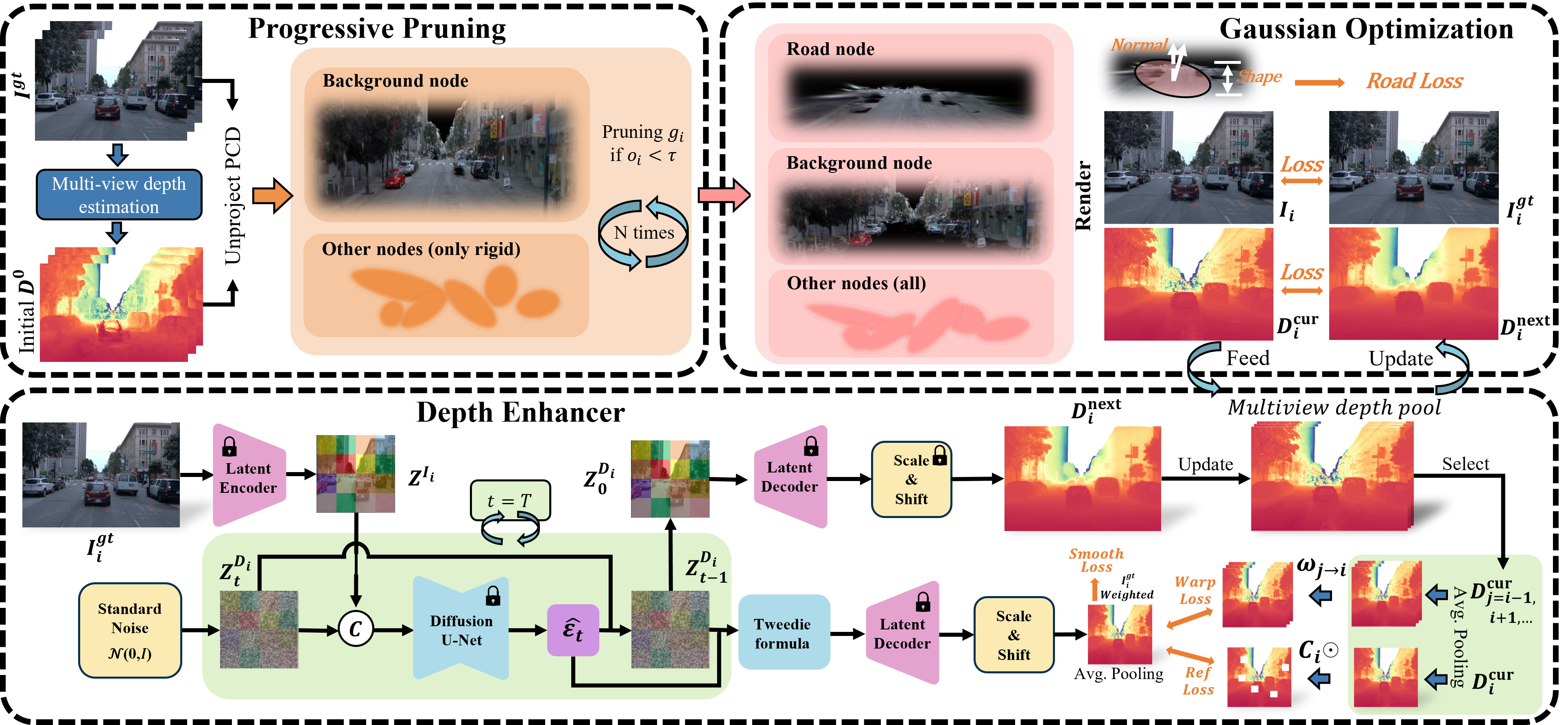
TL;DR: D2GS reconstructs dynamic urban scenes without LiDAR by turning multi-view image depth into dense, refined geometric supervision for Gaussian Splatting.
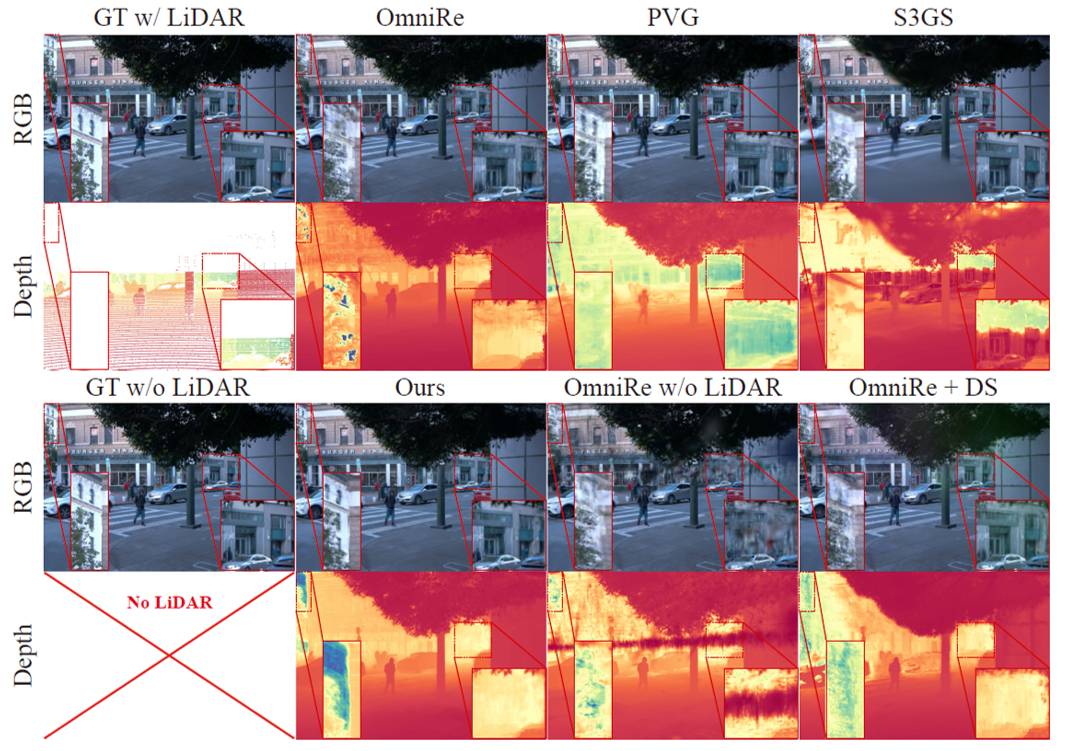
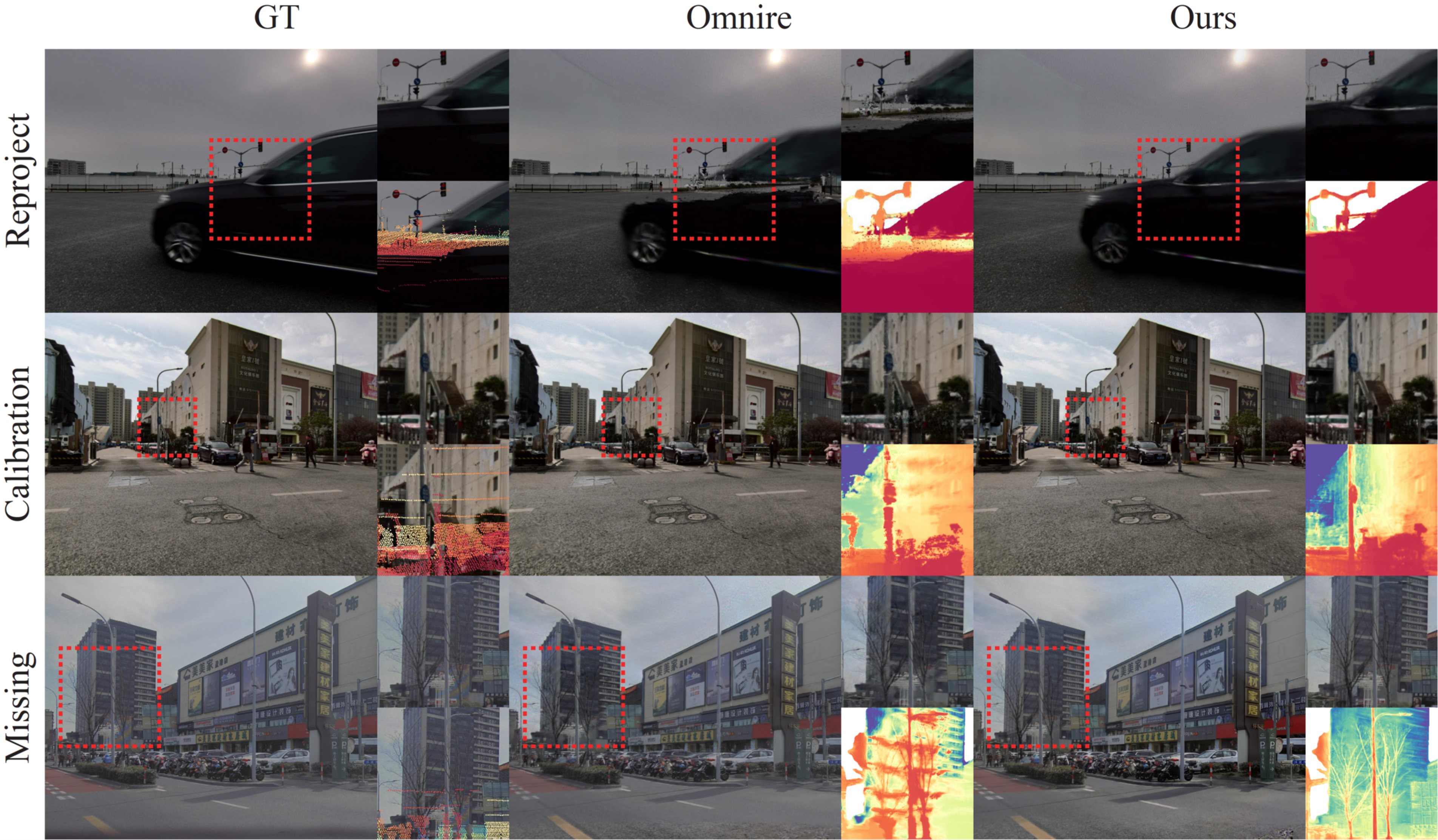
Abstract: Recently, Gaussian Splatting (GS) has shown great potential for urban scene reconstruction in the field of autonomous driving. However, current urban scene reconstruction methods often depend on multimodal sensors as inputs, i.e. LiDAR and images. Though the geometry prior provided by LiDAR point clouds can largely mitigate ill-posedness in reconstruction, acquiring such accurate LiDAR data is still challenging in practice: i) precise spatiotemporal calibration between LiDAR and other sensors is required, as they may not capture data simultaneously; ii) reprojection errors arise from spatial misalignment when LiDAR and cameras are mounted at different locations. To avoid the difficulty of acquiring accurate LiDAR depth, we propose D2GS, a LiDAR-free urban scene reconstruction framework. In this work, we obtain geometry priors that are as effective as LiDAR while being denser and more accurate. First, we initialize a dense point cloud by back-projecting multi-view metric depth predictions. This point cloud is then optimized by a Progressive Pruning strategy to improve the global consistency. Second, we jointly refine Gaussian geometry and predicted dense metric depth via a Depth Enhancer. Specifically, we leverage diffusion priors from a depth foundation model to enhance the depth maps rendered by Gaussians. In turn, the enhanced depths provide stronger geometric constraints during Gaussian training. Finally, we improve the accuracy of ground geometry by constraining the shape and normal attributes of Gaussians within road regions. Extensive experiments on the Waymo dataset demonstrate that our method consistently outperforms state-of-the-art methods, producing more accurate geometry even when compared with those using ground-truth LiDAR data.